Paper Logs vs. Digital: The True Cost of Manual Medication Tracking
The Comfort of Paper — and Its Hidden Price
Paper narcotic logs have been the default in EMS for decades. They're simple, low-tech, and don't require training. But simplicity isn't the same as efficiency, and familiarity doesn't mean effectiveness.
What agencies often don't calculate is the total cost of maintaining a paper-based controlled substance tracking system — the labor, the risk exposure, and the opportunity cost of keeping a process that was never designed to scale. With the Drug Enforcement Administration's (DEA) final rule on the Protecting Patient Access to Emergency Medications Act (PPAEMA) taking effect on March 9, 2026, the standard for accountability has officially outgrown the clipboard.
Labor Costs That Don't Show Up on a Budget Line
Consider what happens when a medication count doesn't add up at shift change. The new DEA rule requires that every dose administered or disposed of includes 11 specific data elements, including the drug name, date, patient identifier, amount, the administering professional's last name or initials, the authorizing medical director's last name or initials, and witness signatures for any wasted medication.
With paper logs, the reconciliation process for a discrepancy typically involves:
- Pulling physical log sheets from the unit, the station, and possibly other vehicles.
- Cross-referencing handwritten entries across multiple providers and shifts to verify all 11 required elements are present.
- Interviewing personnel to reconstruct a timeline.
- Scanning and photocopying documents for the investigation file.
Furthermore, the clock is ticking. Best practice dictates that discrepancies should be resolved within the same shift or 24 hours. If an unexplained loss is deemed significant, federal regulations require you to notify your local DEA Field Division Office in writing within one business day, followed by an electronic submission of DEA Form 106 within 45 calendar days. A single discrepancy investigation can consume 40 or more staff-hours. Multiply that by the handful of variances most agencies experience annually, and the administrative labor cost alone is staggering.
Regulatory Risk Compounds Over Time
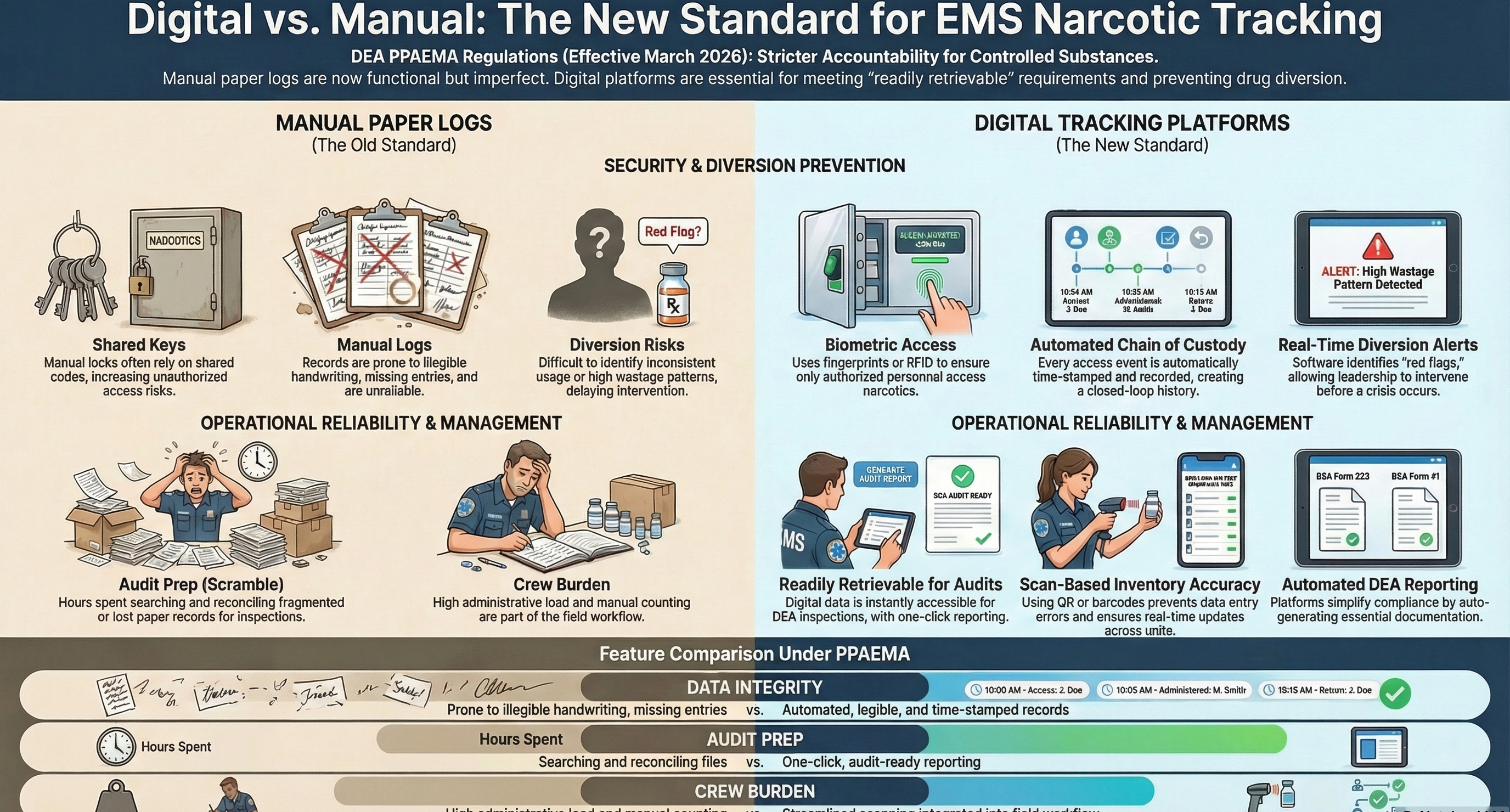
Paper logs don't age well. Ink fades, sheets are misfiled, and binders get lost when stations relocate or vehicles are decommissioned. Under the CSA, the DEA explicitly requires that controlled substance records be "readily retrievable" and maintained for a minimum of two years.
In fact, retired DEA experts cite missing, incomplete, and spotty recordkeeping as some of the most common violations found during EMS inspections. When a regulatory body requests records from 18 months ago, the agency relying on paper often discovers that what they have is incomplete, disorganized, or missing entirely. The inability to produce records on demand doesn't just create compliance risk — it creates the appearance of diversion risk, which can be just as damaging. Auditors can't distinguish between records that were lost and records that never existed.
What Agencies Actually Gain from Going Digital
Moving to an electronic medication log doesn't mean replacing one form with a screen. A well-designed narcotic tracking system changes the underlying workflow, and the DEA's final rule explicitly permits the use of electronic recordkeeping systems.
NarcTrack elevates an agency's compliance by default:
- Verified Identity: Access is controlled via unique PINs and role-based permissions, ensuring no single person has unrestricted, anonymous access.
- Automated Reconciliation: QR codes are scanned with the NarcTrack mobile app upon receipt, transfer, and administration, preventing manual data entry errors and reconciling expected versus actual inventory instantly.
- Immediate Flagging: Counts reconcile automatically, with exceptions and variances flagged immediately for supervisors to investigate.
- Continuous Audit Trails: Every event is timestamped, securely backed up to the cloud, and instantly exportable for an inspector, eliminating the need to dig through physical binders.
The result is less time spent on documentation, dramatically less time spent on investigations, and a verifiable, closed-loop record that stands up to scrutiny whenever it's needed.
Calculating Your Agency's Paper Cost
Most agencies have never added up what paper narcotic tracking actually costs. A useful exercise is to estimate:
- Hours per month spent on daily double-counts, manual log audits, and reconciliation.
- Hours per variance investigation (including all personnel, HR, and supervisor time).
- Number of variances per year that required investigation.
- Time spent tracking down and preparing historical documentation for DEA or state audits.
For a mid-sized EMS agency running 4–6 units, these costs often total tens of thousands of dollars annually — not including the regulatory and reputational risk that can't be quantified until something goes wrong. As the PPAEMA rule ushers in a new era of direct DEA oversight for EMS, investing in a digital tracking system like NarcTrack isn't just about saving time — it's about protecting your clinicians, your patients, and your agency's license to operate.
Ready to see NarcTrack in action?
Talk to our team about how NarcTrack can help your agency build audit-ready medication accountability.